Aspire automates 44% of all correspondence with Kyber
Read More
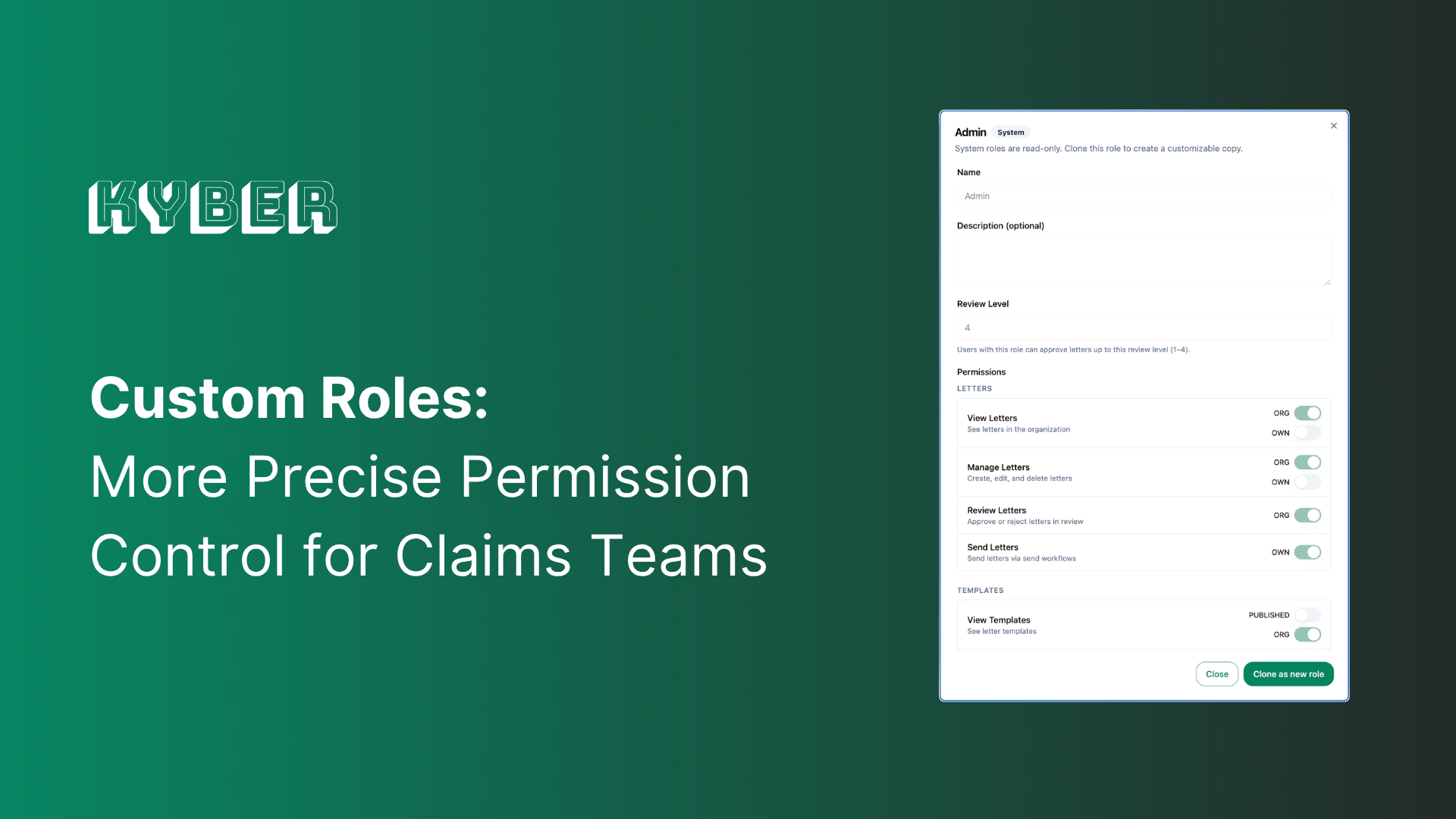
Introducing the Trainee User Role:  Faster Ramp, Stronger Governance
Product Updates

Introducing the Trainee User Role: Faster Ramp, Stronger Governance

Enable new adjusters with Kyber access to learn the claims correspondence workflow, without full production authority on day one

Claims leaders do not just need better correspondence workflows. They also need a safer way to bring new people into those workflows.

Every growing claims organization runs into the same onboarding tension. New adjusters, rotational staff, QA reviewers, and temporary team members need real exposure to the live process to become effective. But full production access on day one can create unnecessary risk. Shared logins are a nonstarter. Manual supervision does not scale. And overly broad permissions can create downstream compliance, quality, and governance issues.

This problem gets exacerbated when teams are hiring quickly, cross-training across lines, or expanding to new business units. The workflow cannot grind to a halt every time a manager needs someone to learn the system. At the same time, the answer cannot be to lower the bar on review structure or auditability.

Introducing Trainee User Access

Trainee User Access gives organizations a governed middle ground between no access and standard user access.

Instead of forcing claims teams to choose between rigid lockout and full production freedom, Trainee User Access is designed to let new users learn by doing inside the real claims correspondence workflow while staying within the right controls. It supports a more practical onboarding model for trainee adjusters, new hires, shadow users, cross-functional reviewers, and other team members who need hands-on exposure before they should operate independently.

In Kyber, that means organizations can expand access with more confidence, keep onboarding inside the platform, and preserve the structure needed for compliant, high-quality correspondence.

How It Works

Trainee User Access is built for organizations that want guided product exposure without opening up unnecessary authority too early.

In practice, this role helps carriers support scenarios like:

  • Onboarding a new adjuster who needs to learn letter workflows in the real environment
  • Supporting rotational staff and TPAs who may need extra reviews during onboarding and onramp periods
  • Expanding Kyber to a new team without giving every user the same level of authority on day one

The larger point is not just permissions for the sake of permissions. It is cleaner separation between learning and production authority.

That matters because claims correspondence is rarely a single action. A user may need to review claim details, draft a letter, route it for review, and understand how approval and send workflows operate across different templates. Trainee User Access gives teams a better way to expose new users to that process while keeping the organization’s governance model intact.

This also fits naturally alongside the rest of Kyber’s workflow controls. Teams that already rely on configurable reviews, audit trails, and structured correspondence processes can bring new users in without stepping outside those standards. For example, organizations can pair Trainee User Access with resources like In-Product Training, Quick Decisions, and Review Workflows to create a more complete onboarding and governance model.

Why This Matters

A trainee role may sound like a small administrative update. In practice, it solves a real adoption problem for claims organizations.

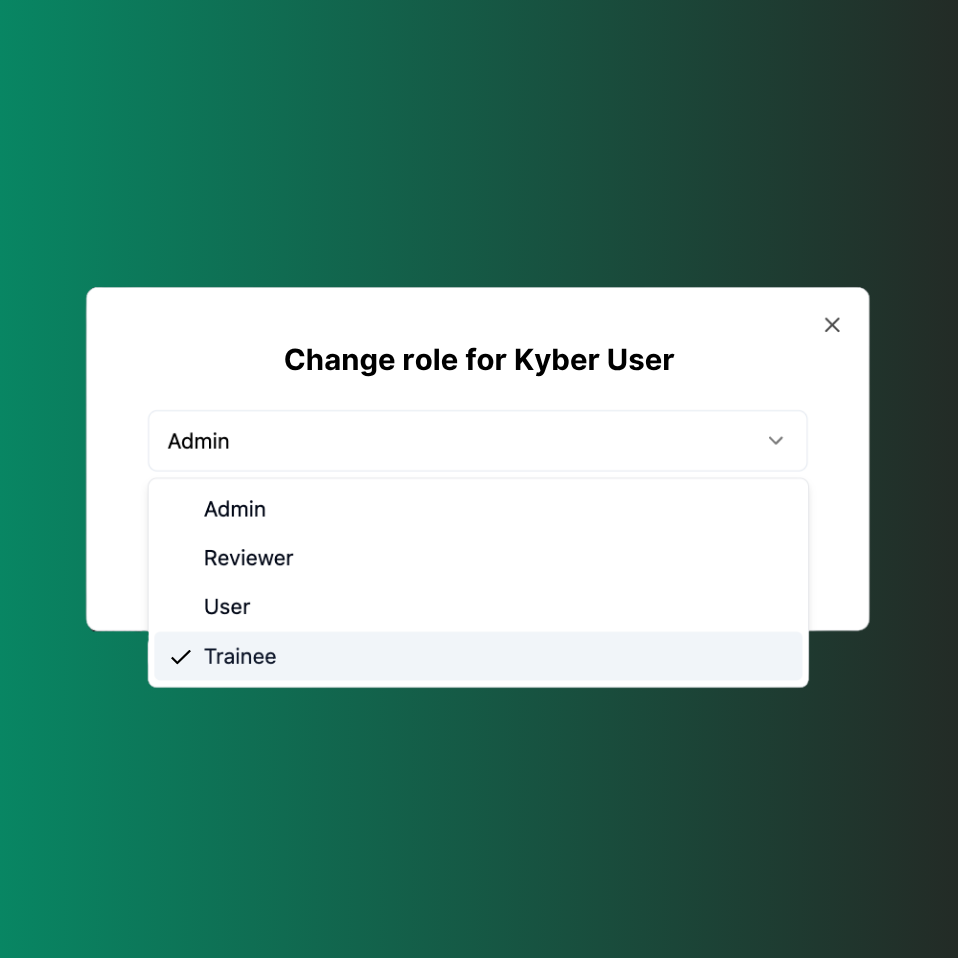
First, it helps reduce the operational friction of onboarding. Managers do not have to rely on workarounds, over-manual supervision, or one-size-fits-all access. New users can get familiar with the workflow faster, which shortens ramp time and lowers the administrative burden on experienced team members. When a trainee is ready to graduate, admins are able to reassign their access to a "user" or "reviewer."

Second, it improves governance. Claims correspondence carries real compliance and customer experience consequences, especially when users are still learning. Better permission boundaries make it easier to maintain review discipline, preserve auditability, and scale usage without creating unnecessary exposure.

Third, it supports broader platform adoption. When claims leaders know they can expand access in a controlled way, it becomes easier to roll Kyber out across more teams and use cases. That is especially important for carriers trying to standardize communication while still accommodating different levels of user experience, approval needs, and operational complexity.

The result is a better balance of efficiency, consistency, and control.

Now Available in Kyber

Claims teams should not have to choose between onboarding speed and operational control.

Trainee User Access gives organizations a more practical way to bring new users into the claims correspondence workflow, with guardrails that support quality, compliance, and confidence as teams scale.

If onboarding, governance, or user ramp time is top of mind for your claims organization, reach out to your CSM or book a demo with Kyber to see how Trainee User Access fits into the broader correspondence workflow.

Contents

No H2 Found

Thank you for subscribing!
From now on you will receive our monthly newsletter to your inbox.
Oops! Something went wrong while submitting the form.

Download Now

Thank you! Your submission has been received!
Oops! Something went wrong while submitting the form.
Free Whitepaper

Introducing the Trainee User Role: Faster Ramp, Stronger Governance

Claims leaders do not just need better correspondence workflows. They also need a safer way to bring new people into those workflows.

Every growing claims organization runs into the same onboarding tension. New adjusters, rotational staff, QA reviewers, and temporary team members need real exposure to the live process to become effective. But full production access on day one can create unnecessary risk. Shared logins are a nonstarter. Manual supervision does not scale. And overly broad permissions can create downstream compliance, quality, and governance issues.

This problem gets exacerbated when teams are hiring quickly, cross-training across lines, or expanding to new business units. The workflow cannot grind to a halt every time a manager needs someone to learn the system. At the same time, the answer cannot be to lower the bar on review structure or auditability.

Introducing Trainee User Access

Trainee User Access gives organizations a governed middle ground between no access and standard user access.

Instead of forcing claims teams to choose between rigid lockout and full production freedom, Trainee User Access is designed to let new users learn by doing inside the real claims correspondence workflow while staying within the right controls. It supports a more practical onboarding model for trainee adjusters, new hires, shadow users, cross-functional reviewers, and other team members who need hands-on exposure before they should operate independently.

In Kyber, that means organizations can expand access with more confidence, keep onboarding inside the platform, and preserve the structure needed for compliant, high-quality correspondence.

How It Works

Trainee User Access is built for organizations that want guided product exposure without opening up unnecessary authority too early.

In practice, this role helps carriers support scenarios like:

  • Onboarding a new adjuster who needs to learn letter workflows in the real environment
  • Supporting rotational staff and TPAs who may need extra reviews during onboarding and onramp periods
  • Expanding Kyber to a new team without giving every user the same level of authority on day one

The larger point is not just permissions for the sake of permissions. It is cleaner separation between learning and production authority.

That matters because claims correspondence is rarely a single action. A user may need to review claim details, draft a letter, route it for review, and understand how approval and send workflows operate across different templates. Trainee User Access gives teams a better way to expose new users to that process while keeping the organization’s governance model intact.

This also fits naturally alongside the rest of Kyber’s workflow controls. Teams that already rely on configurable reviews, audit trails, and structured correspondence processes can bring new users in without stepping outside those standards. For example, organizations can pair Trainee User Access with resources like In-Product Training, Quick Decisions, and Review Workflows to create a more complete onboarding and governance model.

Why This Matters

A trainee role may sound like a small administrative update. In practice, it solves a real adoption problem for claims organizations.

First, it helps reduce the operational friction of onboarding. Managers do not have to rely on workarounds, over-manual supervision, or one-size-fits-all access. New users can get familiar with the workflow faster, which shortens ramp time and lowers the administrative burden on experienced team members. When a trainee is ready to graduate, admins are able to reassign their access to a "user" or "reviewer."

Second, it improves governance. Claims correspondence carries real compliance and customer experience consequences, especially when users are still learning. Better permission boundaries make it easier to maintain review discipline, preserve auditability, and scale usage without creating unnecessary exposure.

Third, it supports broader platform adoption. When claims leaders know they can expand access in a controlled way, it becomes easier to roll Kyber out across more teams and use cases. That is especially important for carriers trying to standardize communication while still accommodating different levels of user experience, approval needs, and operational complexity.

The result is a better balance of efficiency, consistency, and control.

Now Available in Kyber

Claims teams should not have to choose between onboarding speed and operational control.

Trainee User Access gives organizations a more practical way to bring new users into the claims correspondence workflow, with guardrails that support quality, compliance, and confidence as teams scale.

If onboarding, governance, or user ramp time is top of mind for your claims organization, reach out to your CSM or book a demo with Kyber to see how Trainee User Access fits into the broader correspondence workflow.

Showcasing if a notice is approved or pending or denied.

Ready to Modernize Your Claims Process?

We'd love to share more about how Kyber helps claims teams automate so adjusters can focus on policyholders, not admin.

Book Demo
Showcasing if a notice is approved or pending or denied.

Frequently Asked Questions

How is Kyber different from traditional CCMs?

Kyber isn’t just a template library. It uses AI to pull the right policy language, apply jurisdictional rules, and generate accurate notices automatically. Every draft includes a built-in audit trail for full compliance visibility. Unlike legacy CCMs, Kyber is also lightweight to implement and easy to maintain across your claims team.

How does Kyber ensure compliance?

Kyber applies pre-approved templates, inserts only validated policy language, and enforces jurisdictional requirements for every letter. All edits, approvals, and versions are tracked automatically. All your organization's documents are audit-ready by default.

Does Kyber integrate with my existing Claims System?

Yes. Kyber is customizable to your organization’s existing tech stack (including core systems) and processes

How much time does it take to implement Kyber?

Most teams are live within a quarter when integrating with an existing claims system. For new integrations or more complex environments, implementation typically takes up to four months with full support from our onboarding team.

How does Kyber protect my organization’s data?

Kyber supports on-premise and private cloud deployments, and meets SOC 2 Type II compliance standards. You can choose the architecture that aligns with your internal security protocols while maintaining full control over sensitive claims and policy data.