Aspire automates 44% of all correspondence with Kyber
Read More
Large Loss AI Templates: Turning Complex Claim Files Into Clear, Actionable Reports
Product Updates

Large Loss AI Templates: Turning Complex Claim Files Into Clear, Actionable Reports

Kyber’s AI Template turns fragmented claim data into a clear, consistent report while preserving the adjuster judgment severe claims require.

Published on
July 29, 2026

A single severe claim can materially change an insurance program’s financial outlook.

Claims leaders, actuaries, finance teams, executives, capacity providers, and reinsurers all need to understand what happened, how exposure is developing, and what action comes next. The large-loss report gives them that view. It is one of the most consequential documents a claims organization produces, and often one of the most manual.

An experienced adjuster may have to reconstruct the claim from hundreds of notes, documents, estimates, financial transactions, and investigation updates. They must consolidate policy and coverage information, facts of loss, reserves, payments, litigation developments, recovery potential, and next steps into a report that someone outside the claim can quickly understand.

Finding the information is only the beginning. The adjuster must decide which details matter, reconcile facts that have changed or conflict, and explain the reasoning behind the current exposure. A report can include every required data point and still fail its reader when the important developments are buried or disconnected.

Then the claim changes: Reserves move. New injuries or damages emerge. Litigation advances. Each material development may trigger another reporting cycle and another round of reconstruction.

That administrative work falls to the same experienced adjusters needed for investigation, litigation strategy, negotiation, vendor management, and resolution.

Delayed or inconsistent reports can leave carriers and TPAs without a reliable view across severe claims. MGAs face another layer of scrutiny. They may administer the claim, but the exposure and accountability often extend across carrier, capacity, and reinsurance partners.

Large-loss reports are essential. The process used to create them is often unnecessarily repetitive and arduous.

Introducing Kyber’s Large Loss AI Template

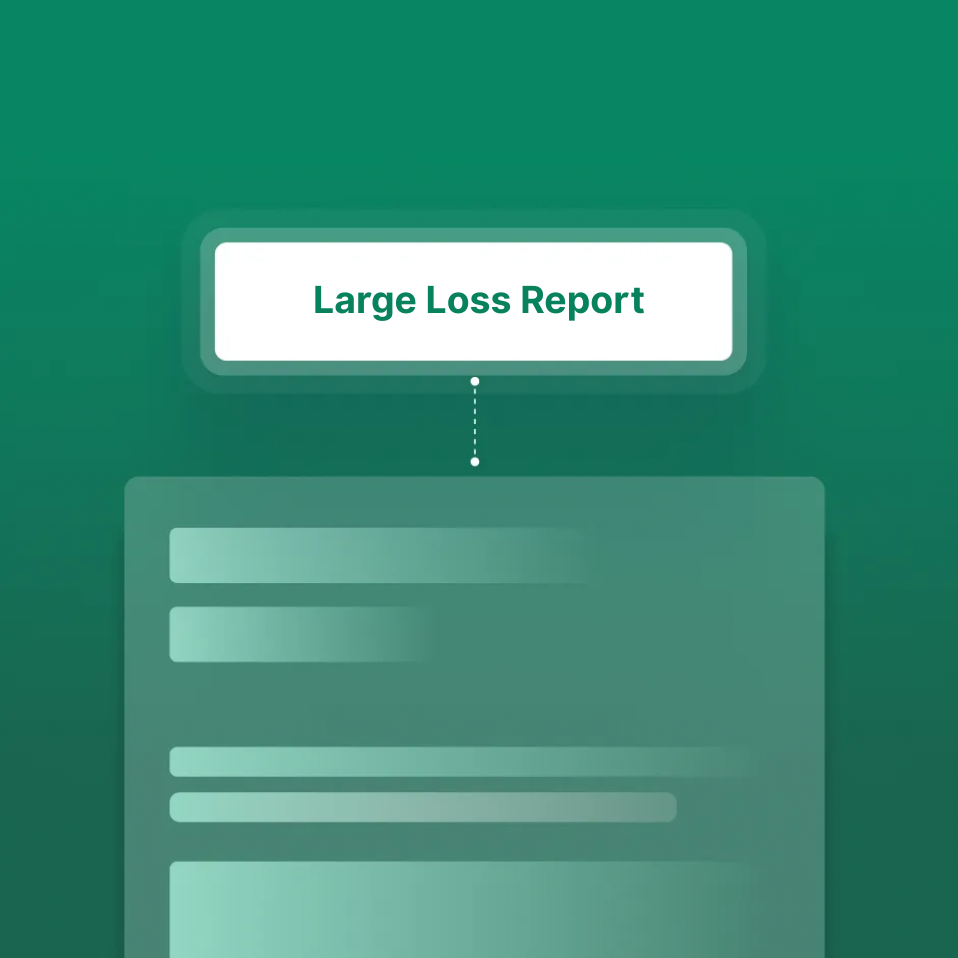
Kyber’s Large Loss AI Template turns raw claim data into a standardized, editable summary.

The adjuster starts with an AI-generated draft rather than a blank document or a manual copy-and-paste process. The draft brings the relevant claim facts and financial exposure together in one place. The result is a scannable snapshot of the claim, its financial position, and the current action plan.

Via the AI template, Kyber brings together:

  • Core claim information: Insured, policy details, date and location of loss, and assigned handler.
  • Coverage limits: What the policy may pay for.
  • Indemnity reserves and payments: Money set aside or paid for the underlying loss.
  • Expense reserves and payments: Money set aside or paid for claim-handling costs.
  • Loss details: A narrative account of what happened.
  • Optional sections: Injuries, litigation, next steps, or subrogation, depending on the template.

The generated report remains editable. The adjuster reviews the content, applies their judgment, and makes any necessary changes before it is shared.

When the claim changes, the team can update an established report instead of reconstructing it from the beginning.

The adjuster still evaluates exposure, determines strategy, and confirms what should be communicated. Kyber does not replace that judgment. It reduces the manual work required to turn a changing claim file into a usable report.

Greater Consistency Around High-Severity Claims

A standardized first draft gives carriers and MGAs a more consistent starting point. Adjusters spend less time piecing together the claim file, while stakeholders receive a clearer view of the loss.

Large-loss reporting will always require human judgment. Kyber's goal is to ensure adjusters are not left to juggle administrative tasks instead of focusing on that judgement.

Contents

No H2 Found

Thank you for subscribing!
From now on you will receive our monthly newsletter to your inbox.
Oops! Something went wrong while submitting the form.

Download Now

Thank you! Your submission has been received!
Oops! Something went wrong while submitting the form.
Free Whitepaper

Large Loss AI Templates: Turning Complex Claim Files Into Clear, Actionable Reports

A single severe claim can materially change an insurance program’s financial outlook.

Claims leaders, actuaries, finance teams, executives, capacity providers, and reinsurers all need to understand what happened, how exposure is developing, and what action comes next. The large-loss report gives them that view. It is one of the most consequential documents a claims organization produces, and often one of the most manual.

An experienced adjuster may have to reconstruct the claim from hundreds of notes, documents, estimates, financial transactions, and investigation updates. They must consolidate policy and coverage information, facts of loss, reserves, payments, litigation developments, recovery potential, and next steps into a report that someone outside the claim can quickly understand.

Finding the information is only the beginning. The adjuster must decide which details matter, reconcile facts that have changed or conflict, and explain the reasoning behind the current exposure. A report can include every required data point and still fail its reader when the important developments are buried or disconnected.

Then the claim changes: Reserves move. New injuries or damages emerge. Litigation advances. Each material development may trigger another reporting cycle and another round of reconstruction.

That administrative work falls to the same experienced adjusters needed for investigation, litigation strategy, negotiation, vendor management, and resolution.

Delayed or inconsistent reports can leave carriers and TPAs without a reliable view across severe claims. MGAs face another layer of scrutiny. They may administer the claim, but the exposure and accountability often extend across carrier, capacity, and reinsurance partners.

Large-loss reports are essential. The process used to create them is often unnecessarily repetitive and arduous.

Introducing Kyber’s Large Loss AI Template

Kyber’s Large Loss AI Template turns raw claim data into a standardized, editable summary.

The adjuster starts with an AI-generated draft rather than a blank document or a manual copy-and-paste process. The draft brings the relevant claim facts and financial exposure together in one place. The result is a scannable snapshot of the claim, its financial position, and the current action plan.

Via the AI template, Kyber brings together:

  • Core claim information: Insured, policy details, date and location of loss, and assigned handler.
  • Coverage limits: What the policy may pay for.
  • Indemnity reserves and payments: Money set aside or paid for the underlying loss.
  • Expense reserves and payments: Money set aside or paid for claim-handling costs.
  • Loss details: A narrative account of what happened.
  • Optional sections: Injuries, litigation, next steps, or subrogation, depending on the template.

The generated report remains editable. The adjuster reviews the content, applies their judgment, and makes any necessary changes before it is shared.

When the claim changes, the team can update an established report instead of reconstructing it from the beginning.

The adjuster still evaluates exposure, determines strategy, and confirms what should be communicated. Kyber does not replace that judgment. It reduces the manual work required to turn a changing claim file into a usable report.

Greater Consistency Around High-Severity Claims

A standardized first draft gives carriers and MGAs a more consistent starting point. Adjusters spend less time piecing together the claim file, while stakeholders receive a clearer view of the loss.

Large-loss reporting will always require human judgment. Kyber's goal is to ensure adjusters are not left to juggle administrative tasks instead of focusing on that judgement.

Showcasing if a notice is approved or pending or denied.

Ready to Modernize Your Claims Process?

We'd love to share more about how Kyber helps claims teams automate so adjusters can focus on policyholders, not admin.

Book Demo
Showcasing if a notice is approved or pending or denied.

Frequently Asked Questions

How is Kyber different from traditional CCMs?

Kyber isn’t just a template library. It uses AI to pull the right policy language, apply jurisdictional rules, and generate accurate notices automatically. Every draft includes a built-in audit trail for full compliance visibility. Unlike legacy CCMs, Kyber is also lightweight to implement and easy to maintain across your claims team.

How does Kyber ensure compliance?

Kyber applies pre-approved templates, inserts only validated policy language, and enforces jurisdictional requirements for every letter. All edits, approvals, and versions are tracked automatically. All your organization's documents are audit-ready by default.

Does Kyber integrate with my existing Claims System?

Yes. Kyber is customizable to your organization’s existing tech stack (including core systems) and processes

How much time does it take to implement Kyber?

Most teams are live within a quarter when integrating with an existing claims system. For new integrations or more complex environments, implementation typically takes up to four months with full support from our onboarding team.

How does Kyber protect my organization’s data?

Kyber supports on-premise and private cloud deployments, and meets SOC 2 Type II compliance standards. You can choose the architecture that aligns with your internal security protocols while maintaining full control over sensitive claims and policy data.