Curious how much Kyber could save your team?
Calculate your ROI
The Culture Advantage: Sam Rea’s Playbook for High-Velocity Automation Inside a Regulated Industry
Expert Guide

The Culture Advantage: Sam Rea’s Playbook for High-Velocity Automation Inside a Regulated Industry

Aspire General’s CTO, Sam Rea, shares how the right company culture turns automation into a fast, reliable driver of operational improvement. When teams expect progress and embrace change, automation delivers meaningful value where it matters most.

Insurance has no shortage of automation promises. For years, carriers have invested in system overhauls, workflow redesigns, and modernization projects meant to simplify claims operations. Yet many of these efforts stall before value reaches the front line. Projects stretch into years. QA processes balloon. Adjusters feel the weight of new tools instead of relief.

According to Aspire General’s CTO, Sam Rea, the issue is not a lack of technology. It is the cultural environment surrounding it.
Sam has spent his career inside carriers of every size. He has watched multimillion-dollar innovation programs collapse under misalignment and overcomplexity. He has also watched smaller, more agile teams transform quickly with far fewer resources. The differentiator is not who has the larger budget. It is who builds a culture that wants automation to succeed.

This culture exists at Aspire and is in no way accidental. It reflects the broader strategic direction set by CEO Byron Storms, whose leadership emphasizes cultural alignment, empowered teams, and pragmatic modernization. His commitment to a tech-forward, people-first operating model has shaped the environment in which Aspire’s automation strategy thrives.

The resulting impact goes beyond efficiency, as the culture helps recruit strong talent and creates an operational foundation where change is expected. People join Aspire believing the work should get easier, cleaner, and more efficient over time. That mindset becomes the soil where automation can take root.

During conversations with Kyber’s CEO, Arvind Sontha, Sam framed automation as an organizational philosophy rather than a tooling effort. The model he uses is grounded in practical experience, tied directly to compliance realities, and shaped by what he has seen work in the field.

What follows is Sam’s playbook for building high-velocity automation inside a regulated industry. It is culture-driven, operationally grounded, and designed for leaders who want modernization that actually makes it into production.

The Hidden Bottleneck in Claims Automation

Claims teams underestimate how much manual activity supports even simple regulated processes. Acknowledgements, status updates, and required notifications all depend on adjusters performing repetitive tasks. They also require QA teams to audit only a small fraction of that work after the fact.

Sam describes the traditional structure succinctly.

“In most claims organizations, you have a team doing the work and another team checking the work. And because QA can only review a small sample, you never get the full picture. Automation gives us the chance to change that model entirely.”

This dual-layer pattern makes automation harder than it appears. Automating only the drafting step still leaves the second team in place. Automating only the audit step leaves adjusters doing work that technology could handle more efficiently. And automating without cultural buy-in leaves both teams skeptical.

Sam’s insight is clear. Carriers often underestimate the operational ecosystem wrapped around a workflow. Automation is not about digitizing a task. It is about redesigning the full chain of activity and oversight so the structure becomes lighter, faster, and more reliable.

Automate the Work and the QA Together

Sam’s central principle is direct and unusually practical. If automation replaces only the task and not the oversight, the organization has not meaningfully changed.

Aspire approaches automation by removing both layers at the same time. When a regulated letter is automated, so is its monitoring. The system checks whether the letter went out, whether it met the deadline, and whether it matched required content. It does this across 100% of files in real time.

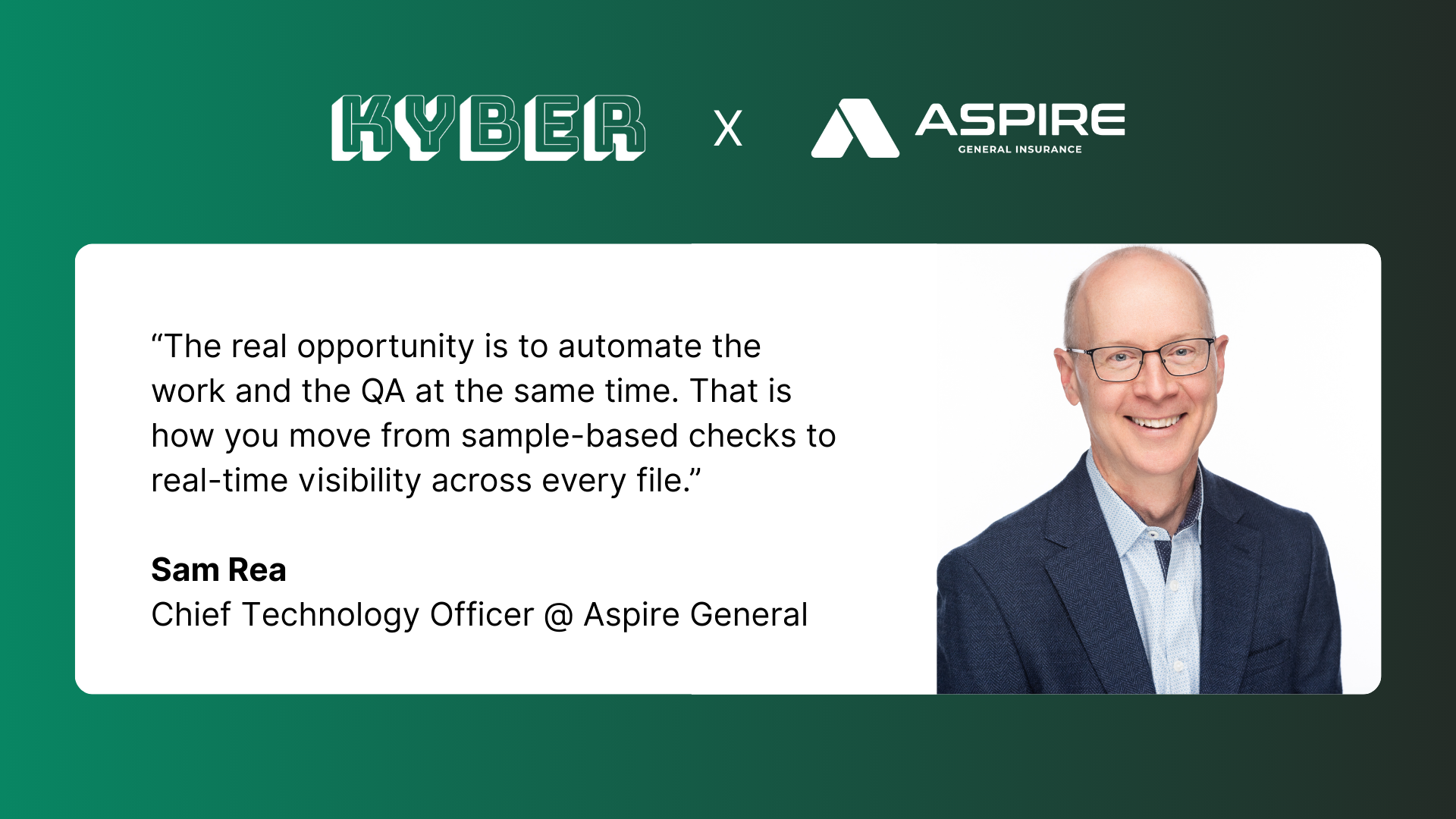
“The real opportunity is to automate the work and the QA at the same time. That is how you move from sample-based checks to real-time visibility across every file.”

This transforms the QA function from a retrospective, sample-based audit into a continuous, exception-driven control system. QA staff move from manual review to higher-value validation and escalation.

The result is not only speed. It is a stronger compliance posture in a world where regulators expect traceability, timeliness, and consistency.

Start Where Regulation, Volume, and Repetition Meet

Carriers often debate where to begin automation. Sam’s approach removes that ambiguity. Choose the workflows that carry the highest manual cost and the highest regulatory consequence.

Acknowledgements. Status notices. Reservation of rights. DOI complaint responses. These are high-volume tasks with predictable structure and fixed deadlines. They are the most natural entrants into automation because impact compounds quickly.

Sam notes that this is less about elegance and more about leverage.

“These are regulated activities that have to happen. People do them manually, and then QA checks them after the fact. There is no reason for that work to stay manual.”

By starting where regulation and repetition overlap, teams see value quickly. That early momentum creates internal demand for further automation rather than resistance to it.

Culture as the Engine of Adoption

While the workflows matter, Sam is explicit that the true differentiator is cultural. Aspire pushes a message repeatedly. The organization will automate everything it reasonably can. Over time, the repetition builds expectation.

Sam describes the effect.

“You keep saying it and eventually people want to be part of it. They start raising their hand. They say, we spend a lot of time doing this one thing. Can we fix it?”

This pattern has created a growing pipeline of automation opportunities not because leadership mandated it, but because the people doing the work feel empowered to shape how it evolves.

Aspire’s operational context amplifies this effect.

  • The company is growing quickly. Leaders spend time onboarding new hires, which increases appetite for removing manual work.

  • The company intentionally partners with tech-forward vendors that move iteratively, which matches Aspire’s internal cadence.

This cultural foundation transforms automation from a project into a habit. It aligns with how Sam describes Aspire’s evolution.

“It starts to build itself.”

Avoiding the Failure Patterns That Slow the Industry

Sam has watched major carriers spend millions on new platforms that never make it to production. He has seen claim systems and policy systems built and abandoned. The reasons are consistent.

  • Projects attempt to solve everything at once.

  • Workflows are designed far from the people who actually use them.

  • Teams insist on zero regression.

  • Organizational reorgs disrupt ownership mid-stream.

Sam takes the opposite approach. Deliver small, functional pieces. Validate them with real users. Expand when ready. Iteration outruns complexity.

As he puts it.

“I am a huge believer in minimum viable products and iterations. If you try to deliver everything all at once, there are too many things that can get in the way.”

This approach is not about moving fast for its own sake. It is about building automation that reaches production, survives organizational change, and earns the trust of the people who depend on it.

A Playbook Leaders Can Use Right Now

Sam’s philosophy forms a coherent model for any carrier pursuing meaningful automation.

  1. Automate both the task and the QA. Relief without oversight is incomplete.

  2. Start with high-volume, regulated, repeatable work. This is where automation earns trust fastest.

  3. Build momentum from the people closest to the work. Participation becomes adoption.

  4. Use your organizational context to accelerate change. Growth, staffing models, and vendor selection all shape receptivity.

  5. Deliver through iteration, not reinvention. Progress is more valuable than perfection.

This is how Aspire moves quickly, strengthens compliance, and maintains a culture that attracts strong technical talent. It is also how automation becomes sustainable rather than fragile.

For leaders navigating the complexity of regulated workflows, Sam’s perspective offers something rare. A practical, cultural blueprint for deploying automation at high velocity without sacrificing accuracy or control. It is not a story about tools. It is a story about people, clarity, and momentum. And it is a path any carrier can follow.
Contents

No H2 Found

Thank you for subscribing!
From now on you will receive our monthly newsletter to your inbox.
Oops! Something went wrong while submitting the form.

Download Now

Thank you! Your submission has been received!
Oops! Something went wrong while submitting the form.
Free Whitepaper

The Culture Advantage: Sam Rea’s Playbook for High-Velocity Automation Inside a Regulated Industry

Insurance has no shortage of automation promises. For years, carriers have invested in system overhauls, workflow redesigns, and modernization projects meant to simplify claims operations. Yet many of these efforts stall before value reaches the front line. Projects stretch into years. QA processes balloon. Adjusters feel the weight of new tools instead of relief.

According to Aspire General’s CTO, Sam Rea, the issue is not a lack of technology. It is the cultural environment surrounding it.

Sam has spent his career inside carriers of every size. He has watched multimillion-dollar innovation programs collapse under misalignment and overcomplexity. He has also watched smaller, more agile teams transform quickly with far fewer resources. The differentiator is not who has the larger budget. It is who builds a culture that wants automation to succeed.

This culture exists at Aspire and is in no way accidental. It reflects the broader strategic direction set by CEO Byron Storms, whose leadership emphasizes cultural alignment, empowered teams, and pragmatic modernization. His commitment to a tech-forward, people-first operating model has shaped the environment in which Aspire’s automation strategy thrives.

The resulting impact goes beyond efficiency, as the culture helps recruit strong talent and creates an operational foundation where change is expected. People join Aspire believing the work should get easier, cleaner, and more efficient over time. That mindset becomes the soil where automation can take root.

During conversations with Kyber’s CEO, Arvind Sontha, Sam framed automation as an organizational philosophy rather than a tooling effort. The model he uses is grounded in practical experience, tied directly to compliance realities, and shaped by what he has seen work in the field.

What follows is Sam’s playbook for building high-velocity automation inside a regulated industry. It is culture-driven, operationally grounded, and designed for leaders who want modernization that actually makes it into production.

The Hidden Bottleneck in Claims Automation

Claims teams underestimate how much manual activity supports even simple regulated processes. Acknowledgements, status updates, and required notifications all depend on adjusters performing repetitive tasks. They also require QA teams to audit only a small fraction of that work after the fact.

Sam describes the traditional structure succinctly.

“In most claims organizations, you have a team doing the work and another team checking the work. And because QA can only review a small sample, you never get the full picture. Automation gives us the chance to change that model entirely.”

This dual-layer pattern makes automation harder than it appears. Automating only the drafting step still leaves the second team in place. Automating only the audit step leaves adjusters doing work that technology could handle more efficiently. And automating without cultural buy-in leaves both teams skeptical.

Sam’s insight is clear. Carriers often underestimate the operational ecosystem wrapped around a workflow. Automation is not about digitizing a task. It is about redesigning the full chain of activity and oversight so the structure becomes lighter, faster, and more reliable.

Automate the Work and the QA Together

Sam’s central principle is direct and unusually practical. If automation replaces only the task and not the oversight, the organization has not meaningfully changed.

Aspire approaches automation by removing both layers at the same time. When a regulated letter is automated, so is its monitoring. The system checks whether the letter went out, whether it met the deadline, and whether it matched required content. It does this across 100% of files in real time.

“The real opportunity is to automate the work and the QA at the same time. That is how you move from sample-based checks to real-time visibility across every file.”

This transforms the QA function from a retrospective, sample-based audit into a continuous, exception-driven control system. QA staff move from manual review to higher-value validation and escalation.

The result is not only speed. It is a stronger compliance posture in a world where regulators expect traceability, timeliness, and consistency.

Start Where Regulation, Volume, and Repetition Meet

Carriers often debate where to begin automation. Sam’s approach removes that ambiguity. Choose the workflows that carry the highest manual cost and the highest regulatory consequence.

Acknowledgements. Status notices. Reservation of rights. DOI complaint responses. These are high-volume tasks with predictable structure and fixed deadlines. They are the most natural entrants into automation because impact compounds quickly.

Sam notes that this is less about elegance and more about leverage.

“These are regulated activities that have to happen. People do them manually, and then QA checks them after the fact. There is no reason for that work to stay manual.”

By starting where regulation and repetition overlap, teams see value quickly. That early momentum creates internal demand for further automation rather than resistance to it.

Culture as the Engine of Adoption

While the workflows matter, Sam is explicit that the true differentiator is cultural. Aspire pushes a message repeatedly. The organization will automate everything it reasonably can. Over time, the repetition builds expectation.

Sam describes the effect.

“You keep saying it and eventually people want to be part of it. They start raising their hand. They say, we spend a lot of time doing this one thing. Can we fix it?”

This pattern has created a growing pipeline of automation opportunities not because leadership mandated it, but because the people doing the work feel empowered to shape how it evolves.

Aspire’s operational context amplifies this effect.

  • The company is growing quickly. Leaders spend time onboarding new hires, which increases appetite for removing manual work.

  • The company intentionally partners with tech-forward vendors that move iteratively, which matches Aspire’s internal cadence.

This cultural foundation transforms automation from a project into a habit. It aligns with how Sam describes Aspire’s evolution.

“It starts to build itself.”

Avoiding the Failure Patterns That Slow the Industry

Sam has watched major carriers spend millions on new platforms that never make it to production. He has seen claim systems and policy systems built and abandoned. The reasons are consistent.

  • Projects attempt to solve everything at once.

  • Workflows are designed far from the people who actually use them.

  • Teams insist on zero regression.

  • Organizational reorgs disrupt ownership mid-stream.

Sam takes the opposite approach. Deliver small, functional pieces. Validate them with real users. Expand when ready. Iteration outruns complexity.

As he puts it.

“I am a huge believer in minimum viable products and iterations. If you try to deliver everything all at once, there are too many things that can get in the way.”

This approach is not about moving fast for its own sake. It is about building automation that reaches production, survives organizational change, and earns the trust of the people who depend on it.

A Playbook Leaders Can Use Right Now

Sam’s philosophy forms a coherent model for any carrier pursuing meaningful automation.

  1. Automate both the task and the QA. Relief without oversight is incomplete.

  2. Start with high-volume, regulated, repeatable work. This is where automation earns trust fastest.

  3. Build momentum from the people closest to the work. Participation becomes adoption.

  4. Use your organizational context to accelerate change. Growth, staffing models, and vendor selection all shape receptivity.

  5. Deliver through iteration, not reinvention. Progress is more valuable than perfection.

This is how Aspire moves quickly, strengthens compliance, and maintains a culture that attracts strong technical talent. It is also how automation becomes sustainable rather than fragile.

For leaders navigating the complexity of regulated workflows, Sam’s perspective offers something rare. A practical, cultural blueprint for deploying automation at high velocity without sacrificing accuracy or control. It is not a story about tools. It is a story about people, clarity, and momentum. And it is a path any carrier can follow.
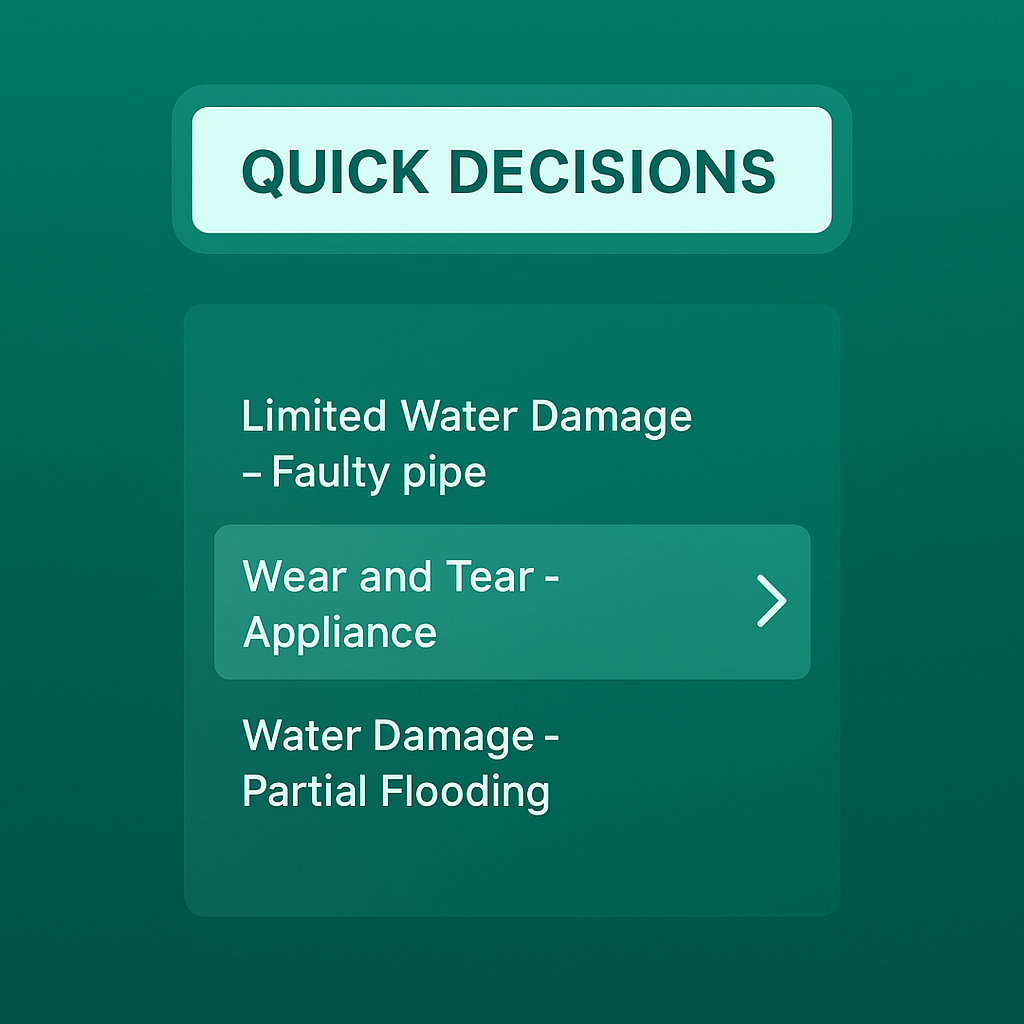
Showcasing if a notice is approved or pending or denied.

Ready to Modernize Your Claims Process?

We'd love to share more about how Kyber helps claims teams automate so adjusters can focus on policyholders, not admin.

Book Demo
Showcasing if a notice is approved or pending or denied.

Frequently Asked Questions

How is Kyber different from traditional CCMs?

Kyber isn’t just a template library. It uses AI to pull the right policy language, apply jurisdictional rules, and generate accurate notices automatically. Every draft includes a built-in audit trail for full compliance visibility. Unlike legacy CCMs, Kyber is also lightweight to implement and easy to maintain across your claims team.

How does Kyber ensure compliance?

Kyber applies pre-approved templates, inserts only validated policy language, and enforces jurisdictional requirements for every letter. All edits, approvals, and versions are tracked automatically. All your organization's documents are audit-ready by default.

Does Kyber integrate with my existing Claims System?

Yes. Kyber is customizable to your organization’s existing tech stack (including core systems) and processes

How much time does it take to implement Kyber?

Most teams are live within a quarter when integrating with an existing claims system. For new integrations or more complex environments, implementation typically takes up to four months with full support from our onboarding team.

How does Kyber protect my organization’s data?

Kyber supports on-premise and private cloud deployments, and meets SOC 2 Type II compliance standards. You can choose the architecture that aligns with your internal security protocols while maintaining full control over sensitive claims and policy data.